
Sydney, Australia 29 June 2026
Clarity Pharmaceuticals (ASX: CU6) (“Clarity” or “Company”), a clinical-stage radiopharmaceutical company with a mission to develop next-generation products that improve treatment outcomes for patients with cancer, is pleased to announce the acceptance of data on 64Cu-SAR-bisPSMA and 67Cu-SAR-bisPSMA for presentation at the European Association of Nuclear Medicine (EANM) Annual Congress 2026, to be held on October 17-21 in Vienna, Austria. These include:
- Top Rated Oral Presentation of data from the Co-PSMA investigator-initiated trial (IIT) with 64Cu-SAR-bisPSMA, led by Prof Louise Emmett at St Vincent’s Hospital, Sydney.
- Three-patient case report on detection of prostate cancer recurrence using 64Cu-SAR-bisPSMA following negative standard-of-care (SOC) prostate-specific membrane antigen (PSMA) positron emission tomography (PET) scan on Siemens Biograph Vision Quadra.
- Case reports from the theranostic Phase I/IIa SECuRE trial1 on two participants with metastatic castration-resistant prostate cancer (mCRPC) who achieved undetectable disease following 67Cu-SAR-bisPSMA treatment as reported this year.
EANM 2026 Annual Congress is one of the world’s leading nuclear medicine conferences and the acceptance of these abstracts is testament to the strength of the data generated by Clarity’s products and the promising prospects for SAR-bisPSMA to change the paradigm in the diagnosis and treatment of prostate cancer.
64Cu-SAR-bisPSMA
Prof Emmett’s Co-PSMA trial compared 64Cu-SAR-bisPSMA head-to-head with the current SOC 68Ga-PSMA-11 PET/computed tomography (CT) in patients in biochemical recurrence (BCR) of prostate cancer with low PSA, following radical prostatectomy. The study demonstrated improved diagnostic performance of 64Cu-SAR-bisPSMA next-day imaging vs. 68Ga-PSMA-11 across all key parameters assessed, including mean number of lesions per participant (1.26 vs. 0.48, p<0.0001), total number of lesions (63 vs. 24), true positive rate (71% vs. 29%) and proportion of participants with a positive scan (78% vs. 36%, respectively)2.
In addition to the Co-PSMA presentation, 64Cu-SAR-bisPSMA is also being highlighted through real-world case profiles. The case study abstract reports on three patients with BCR of prostate cancer who were negative on SOC PSMA PET/CT (68Ga-PSMA-11 and/or 18F-DCFPyL) using Siemens Biograph Vision Quadra, but positive with subsequent 64Cu-SAR-bisPSMA PET/CT in all three cases. Baseline prostate-specific antigen (PSA) in the 3 patients ranged from 1.4–21.0 ng/mL. Next-day imaging (24 hours post-injection) detected a 2.25-fold increase in lesions (nine versus four) compared with same-day (1 hour post-injection) imaging, with additional lesions identified in the prostate bed and lymph nodes. For the lesions visible at both 64Cu-SAR-bisPSMA imaging timepoints, mean maximum standardised uptake value (SUVmax) increased from 3.5 to 6.1, a 1.8-fold increase in tracer uptake.
Importantly, 64Cu-SAR-bisPSMA imaging changed planned clinical management in all three patients. In one patient this enabled targeted radiotherapy to 64Cu-SAR-bisPSMA-positive lesions and allowed androgen deprivation therapy (ADT) to be deferred over a 3-year period while achieving PSA responses, a patient-centric relevant outcome given the side-effect burden of ADT2.
The patient described above, Steve Hunter, who received 64Cu-SAR-bisPSMA under compassionate use, commented, “I was diagnosed with prostate cancer in 2016 and initially had the usual treatment of a prostatectomy and radiation therapy. Although initially quite successful, in 2023 my blood PSA indicated that my cancer was returning, doubling every six months. With SOC PSMA imaging currently available, no lesions were detectable. I was informed by more than one doctor that what I had was a micro-metastatic version of prostate cancer; that is, I had a large number of cancers too small to be detected, and worse, my only option was ADT and the significant side effects I would suffer.
“My recent career has been dedicated to the area of advanced medical imaging utilising PET, single-photon emission computed tomography (SPECT) and magnetic resonance imaging (MRI). I have also worked in the past in oncology research. My experiences led me to believe that what I really had were a small number of tumours that were undetectable by the current SOC PSMA PET/CT imaging even on a state-of-the-art PET/CT system. I contacted Dr Alan Taylor in 2023 and asked if there was any possibility of being tested using their next-day imaging, knowing that this would significantly enhance the chance of finding these tumours. The results were beyond my expectations. Three tumours were found and I underwent targeted external beam radiation. Since then, I have repeated this process with Clarity and Alan’s support a few times to scan, find and subsequently treat the ensuant small number of tumours that arise, with stereotactic radiation therapy.
“I am so grateful to Clarity in making these scans available. This approach has proven to be highly successful by allowing me to obtain clear information about my disease and defer requiring ADT therapy and all the associated side effects with this treatment. I am currently symptom-free and hope to remain like this for a long time. It certainly demonstrates the importance of this agent for patients like me.”
67Cu-SAR-bisPSMA
The therapeutic potential of 67Cu-SAR-bisPSMA is also being showcased at the EANM 2026 Annual Congress through a case study of the two participants from Clarity’s Phase I/IIa SECuRE trial1, a theranostic study in mCRPC that Clarity reported earlier this year. Both participants had Stage IV mCRPC at study entry. Participant A (64 years old, baseline PSA: 6.06 ng/mL with metastatic bone disease) received prior definitive radiotherapy and ADT, docetaxel for metastatic hormone-sensitive disease and enzalutamide for mCRPC with additional palliative stereotactic body radiotherapy. He went on to receive four cycles of 67Cu-SAR-bisPSMA across 5 months. His PSA declined by 95.7% to 0.26 ng/mL within 4 weeks of first cycle and became undetectable (limit of detection 0.02 ng/mL) after the third cycle, remaining undetectable at 33 weeks (last follow-up). No metastatic disease was detected on follow-up bone scan and 64Cu-SAR-bisPSMA PET/CT following treatment with 67Cu-SAR-bisPSMA.
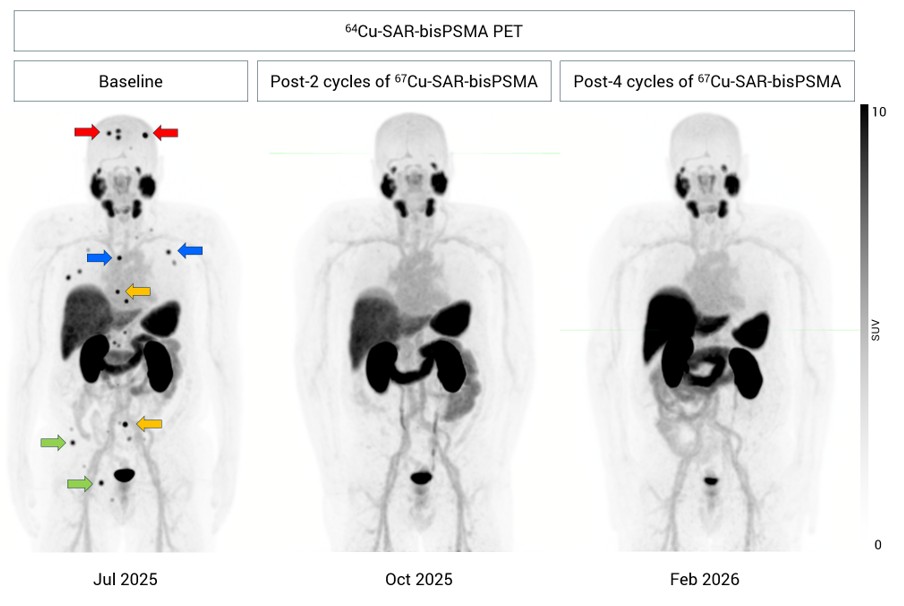
Figure 1. Patient A: Lesion uptake of 64Cu-SAR-bisPSMA PET at baseline (left), following two cycles of 67Cu-SAR-bisPSMA (8 GBq each; centre) and following four cycles of 67Cu-SAR-bisPSMA (right). Coloured arrows indicate metastatic bone lesions within each region: red – skull; blue – ribs and sternum; orange – spine; green – pelvis. No detectable disease was observed on the post-treatment PET. Images are shown as maximum intensity projections. SUV: standardised uptake value.
Participant B (76 years old, baseline PSA: 3.25 ng/mL with nodal metastases) had undergone salvage prostate fossa radiotherapy with ADT and later progressed to mCRPC treated with abiraterone and ongoing ADT. He received two cycles of 67Cu-SAR-bisPSMA across 2 months, with concomitant enzalutamide. His PSA declined by 94.2% to 0.19 ng/mL within 4 weeks of first cycle and was undetectable at 8 weeks, remaining undetectable at 16 weeks (last follow-up), with a complete response per Response Evaluation Criteria in Solid Tumors v1.1 (RECIST) and undetectable disease on 64Cu-SAR-bisPSMA PET/CT after two cycles of treatment.
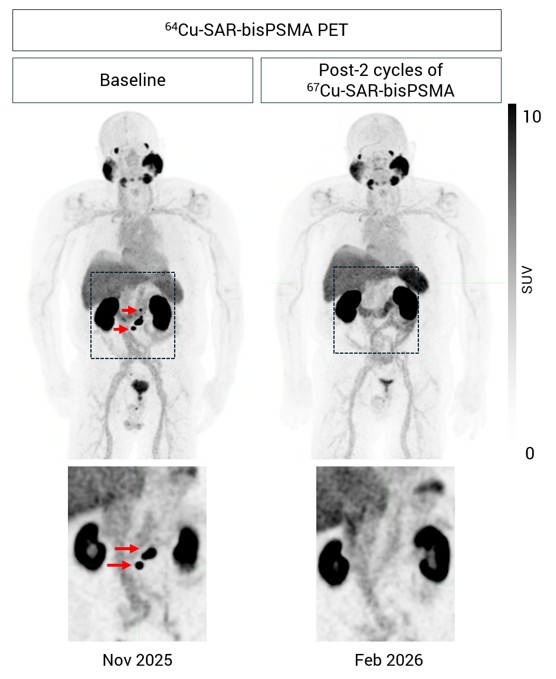
Figure 2. Patient B: Lesion uptake of 64Cu-SAR-bisPSMA PET at baseline (left images) and following two cycles of 67Cu-SAR-bisPSMA (8 GBq each; right images). PET images on the right were acquired 1 month after the second cycle and show no lesion uptake of 64Cu-SAR-bisPSMA compared to baseline. Red arrows indicate metastatic nodal lesions. Top images: maximum intensity projections. Bottom images: coronal sections of the corresponding insets. SUV: standardised uptake value.
Both participants experienced mostly mild and transient 67Cu-SAR-bisPSMA-related adverse events, with Participant A reporting Grade 1 nausea, vomiting, flu-like symptoms (all resolved) and Participant B having Grade 1 altered taste, dry eyes, eye pain, fatigue, salivary gland soreness (all resolved) as well as Grade 2 anaemia (ongoing at the last assessment).
Dr Alan Taylor, Executive Chairperson of Clarity Pharmaceuticals, commented, “The EANM Annual Congress is a conference focused specifically in our area of nuclear medicine, and we are very pleased to see Professor Louise Emmett and her team receive yet another Top Rated Oral Presentation for her excellent work on the Co-PSMA trial, which corroborated previously reported improvement in diagnostic performance of 64Cu-SAR bisPSMA over SOC PSMA imaging in BCR patients3. The Co-PSMA data has already been published in a high impact factor journal, European Urology2, and presented at the European Association of Urology 2026 conference. This additional recognition from EANM is testament to the high quality and clinical relevance of this head-to-head trial.
“Data from trials with 64Cu-SAR-bisPSMA to date2,3,4 provide an early view of what is expected to be the largest single body of work ever undertaken on PSMA imaging agents comparing same-day and next-day imaging in the pre-prostatectomy and BCR spaces, supporting our two ongoing registrational Phase III clinical trials5,6. Furthermore, we have now generated head-to-head data in a range of clinical trials where 64Cu-SAR-bisPSMA has always outperformed SOC imaging under multiple conditions. As part of this commitment to the highest standard of clinical validation and rigor, we have also continued to generate data under the Special Access Scheme (SAS) in Australia and Expanded Access Program (EAP) in the US, building a growing body of real-world evidence that complements and confirms the findings of clinical trial data generated to date, which we will continue to release to the market in preparation for commercialisation. This body of knowledge is now in the range of 700-800 patients dosed with 64Cu-SAR-bisPSMA and imaged on a wide range of different cameras, spanning multiple geographies and numerous clinical settings. Beyond the data, what drives our team in the development of this product is the effect it can have on patients’ lives and the positive feedback we continue to receive from clinicians and patients. The ability to detect lesions where other products cannot and have a real, positive impact on a cancer journey of men and their families battling this disease is what unites and motivates our team and collaborators to persevere and work harder towards our mutual goal.
“We recognise that there is significant interest in this product, which is expected, given its potential to change the diagnostic field and reshape treatment pathways in prostate cancer management. This is why we continue to design and support robust clinical trials with rigorous methodologies and work directly with clinicians through SAS and EAP programs, including head-to-head studies against SOC imaging and investigating same-day versus next-day imaging. We will continue to release these data, all in preparation to enter the large and growing market of PSMA PET imaging with our continued audacious goal of taking a product from the Australian benchtop to blockbuster status. In the entire history of Australian life sciences, this has only been achieved by a number of pharmaceutical products you can count on one hand, the most widely recocognised of which is Gardasil. At Clarity, with clinical trials on track and our regulatory, manufacturing, medical, clinical and commercial teams in place, we are entirely committed to this goal, especially for our fellow teammates, our shareholders and the patients we serve. This is a truly Australian story, with the potential to deliver meaningful impact for patients around the world.
“At Clarity, this does not stop at diagnostic products, and our core mission continues to be to improve treatment outcomes for patients with cancer. 67Cu-SAR-bisPSMA represents a key asset within our therapeutic portfolio for achieving this goal. The continued encouraging results from the SECuRE trial, together with the two most recently announced cases where participants achieved undetectable disease, further build on a growing body of evidence supporting the clinical potential of 67Cu-SAR-bisPSMA to make a difference in the lives of prostate cancer patients. In the two mCRPC patients, 67Cu-SAR-bisPSMA demonstrated marked anti-tumour activity with only three or fewer cycles, leading to undetectable disease by PSA and imaging, with most adverse events being mild and transient. These findings reinforce the potential role of 67Cu-SAR-bisPSMA in addressing a significant unmet need in mCRPC treatment.”
| Product | Abstract Title |
| 64Cu-SAR-bisPSMA | Top Rated Oral Presentation: #1803 Prospective Comparison of 64Copper[64Cu]SAR-bisPSMA vs 68Gallium[68Ga] PSMA-11 PET/CT for Biochemical Recurrence of Prostate Cancer Following Radical Prostatectomy (Co-PSMA Trial)Session Date: Monday, October 19 2026 Session Time: 8:00AM – 9:30AM |
| 64Cu-SAR-bisPSMA | E-Poster: #296 Real-world Detection of Prostate Cancer Recurrence With 64Cu-SAR-bisPSMA Imaging Following Negative Standard-Of-Care PSMA PET: A Three-Patient Case Report |
| 67Cu-SAR-bisPSMA | E-Poster: #1786 67Cu-SAR-bisPSMA leads to Undetectable Disease in Metastatic Castration-Resistant Prostate Cancer Patients: Two Case Reports From The Phase I/IIa SECuRE Trial |
Presentations will be available on Clarity’s official website after the EANM 2026 Congress: claritypharmaceuticals.com/pipeline/scientific_presentations
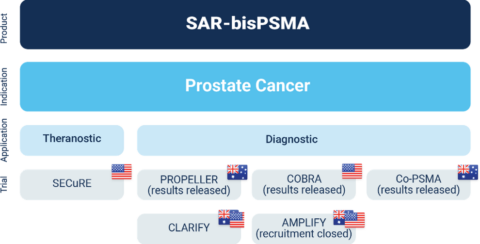
Overview of Clarity’s SAR-bisPSMA clinical program
About SAR-bisPSMA
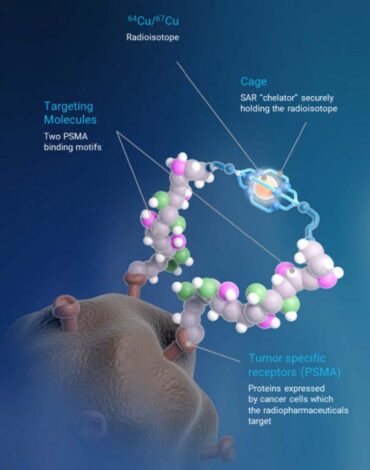
SAR-bisPSMA derives its name from the word “bis”, which reflects a novel approach of connecting two PSMA-targeting agents to Clarity’s proprietary sarcophagine (SAR) technology that securely holds copper isotopes inside a cage-like structure, called a chelator. Unlike other commercially available chelators, the SAR technology prevents copper leakage into the body. SAR-bisPSMA is a Targeted Copper Theranostic (TCT) that can be used with isotopes of copper-64 (Cu-64 or 64Cu) for imaging and copper-67 (Cu-67 or 67Cu) for therapy.
Disclaimer
64Cu-SAR-bisPSMA and 67Cu-SAR-bisPSMA are unregistered products. Their safety and efficacy have not been assessed by health authorities such as the US Food and Drug Administration (FDA) or the Therapeutic Goods Administration (TGA). There is no guarantee that these products will become commercially available.
About Prostate Cancer
Prostate cancer is the second most common cancer diagnosed in men globally and the fifth leading cause of cancer death in men worldwide7. Prostate cancer is the second-leading cause of cancer death in American men. The American Cancer Institute estimates there will be about 333,830 new cases of prostate cancer in the US in 2026 and around 36,320 deaths from the disease8.
About Clarity Pharmaceuticals
Clarity is a clinical-stage radiopharmaceutical company focused on the treatment of serious diseases. The Company is a leader in innovative radiopharmaceuticals, developing Targeted Copper Theranostics based on its SAR Technology Platform for the treatment of cancers.
References
- Clinicaltrials.gov Identifier: NCT04868604. https://clinicaltrials.gov/study/NCT04868604
- Khan S, Papa N, Kneebone A, et al. Prospective Comparison of 64Copper [64Cu]SAR-bisPSMA vs 68Gallium[68Ga] PSMA-11 PET/CT for Biochemical Recurrence of Prostate Cancer Following Radical Prostatectomy (Co-PSMA Trial). Eur Urol. In press. http://dx.doi.org/10.1016/j.eururo.2026.03.001. European Urology, 2026.
- Nordquist L, et al. J Urol. 2025. https://doi.org/10.1097/01.JU.0001109868.09667.98.01
- Lengyelova & Emmett et al. 64Cu-SAR-bisPSMA (PROPELLER) positron emission tomography (PET) imaging in patients with confirmed prostate cancer. ASCO 2023. Poster available at: https://www.claritypharmaceuticals.com/pipeline/scientific_presentations/
- gov Identifier: NCT06970847. https://clinicaltrials.gov/study/NCT06970847
- gov Identifier: NCT06056830. https://clinicaltrials.gov/study/ NCT06056830
- Global Cancer Statistics 2020: GLOBOCAN Estimates of Incidence and Mortality Worldwide for 36 Cancers in 185 Countries. https://acsjournals.onlinelibrary.wiley.com/doi/10.3322/caac.21660
- American Cancer Society: Key Statistics for Prostate Cancer. https://www.cancer.org/cancer/prostate-cancer/about/key-statistics.html
Media Contacts
Dr Alan Taylor
Executive Chairperson
ataylor@claritypharm.com
Lisa Sadetskaya
Director, Corporate Communications
lisa@claritypharm.com
This announcement has been authorised for release by the Executive Chairperson.
